
What Is Dissociation? | Squamish Trauma Therapy

Have you ever caught yourself doing something and thought, "wait, when did I start doing that?" or feel suddenly completely overwhelmed by an emotion that left you feeling disoriented, paralyzed, and utterly perplexed?
Most people have a mental picture of dissociation as something rare, dramatic, and sensationalized as result of the portrayal of dissociation in media. In reality, it's one of the most common human experiences there is, and most of us live with some version of it without ever putting a name to it.
Dissociation, in the simplest terms, is a kind of disconnection: from your surroundings, your body, your emotions, or your sense of who you are. It exists on a wide spectrum, and understanding where your own experiences fall on that spectrum can bring a surprising amount of relief.
The Many Faces of Dissociation
Dissociation doesn't look the same for everyone, and it rarely looks like what people expect. Here are some of the ways it commonly shows up:
Losing time. Getting so absorbed in a book, a task, or a drive that entire stretches of time seem to disappear, or finishing a conversation or presentation with almost no memory of what you actually said.
Feeling like a passenger in your own body. A sense that your body is acting on its own, going through the motions of a task while your mind is somewhere else entirely.
A familiar world turning strange. A person, place, or moment that should feel completely ordinary suddenly feeling unreal or far away, as though you're viewing your own life from behind glass.
Shifting depending on who you're with. Noticing that you feel like a slightly different version of yourself in different settings or relationships, sometimes so much so that it's hard to say which version is the "real" one.
Delayed or missing emotion. A stressful or painful event that doesn't seem to affect you at all in the moment, only to hit later, sometimes much later, once it's finally safe enough to feel it.
Reacting strongly, then blanking. Saying or doing something out of a sudden, intense emotional wave, then having little or no memory of exactly what happened once it passes.
Watching yourself from the outside. The sense of observing your own life like a movie, watching yourself act rather than feeling like you're the one acting.
Losing yourself in what others need. Becoming so focused on someone else's expectations or emotions that you briefly lose track of what you actually think or feel.
If several of these sound familiar, you're in good company. Research suggests dissociative symptoms are about as common as symptoms of anxiety or depression, most people simply don't have a word for them, so they rarely come up in conversation, even with a therapist.
What People Say It Feels Like
Dissociation is easier to recognize in your own life once you've heard someone else put it into words. Here's how people sometimes describe it, in language you might see a piece of yourself in:
"Sometimes I'll be mid-conversation and realize I have no idea what the other person just said, even though I was looking right at them."
"I looked down at my own hands the other day, and for a second they didn't feel like mine."
"I can be laughing with my friends one minute, then suddenly feel like I'm watching the whole scene from a few feet outside my body."
"After an argument with my partner, I sometimes can't recall half of what I said, even a few minutes later."
"I'll snap out of a grocery run and realize I don't remember choosing half the things sitting in my cart."
"At work I'm confident and put together. At home, I barely recognize that version of myself."
"During my dad's funeral, I felt strangely calm and far away, like I was watching it happen through a window. The grief didn't actually hit until weeks later."
"I've caught myself standing in a room with no memory of walking there."
Why This Happens
Dissociation is not a flaw or a sign of instability. It's an adaptive survival response, one of the mind's oldest tools for coping with something overwhelming. All mammals dissociate. When a moment is too much to fully process, whether that's a single frightening event or the slow accumulation of everyday stress, the mind creates distance as a way of getting through it.
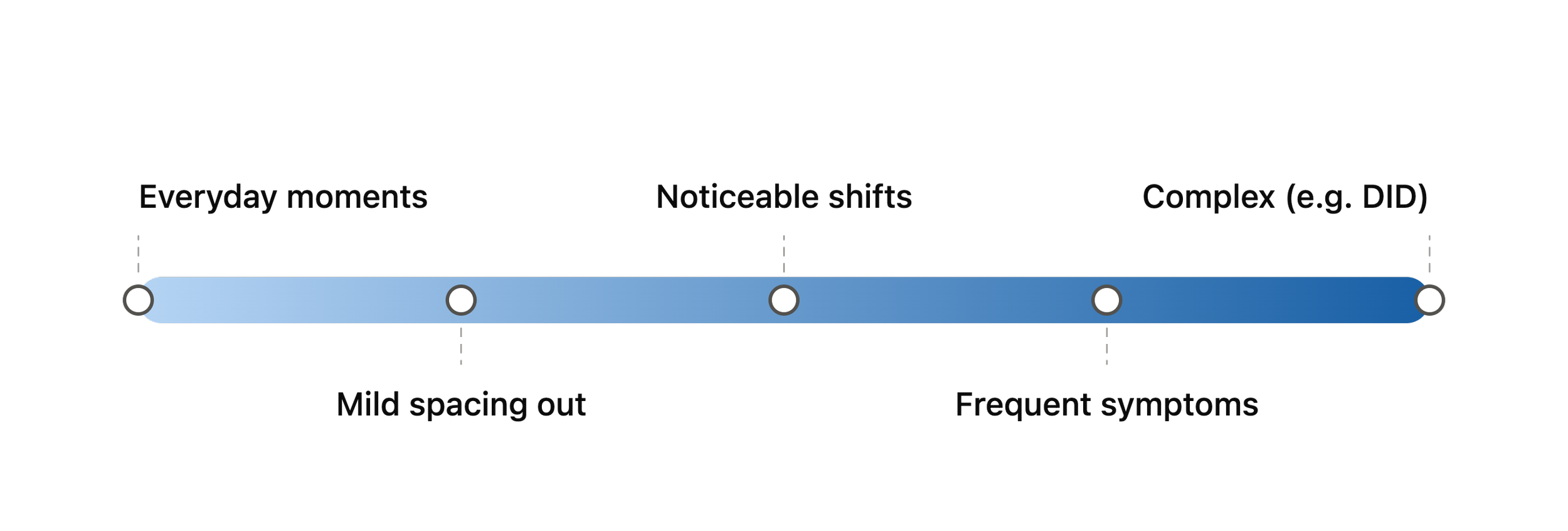
Dissociation shows up on a spectrum (see image below). For most people, this shows up in mild, occasional ways such as what we call highway hypnosis or zoning out when we are bored. For others, especially those who lived through repeated or prolonged trauma, dissociation can become a more constant presence, showing up often enough to interfere with relationships, work, or a stable sense of self.
When It's More Than Occasional
There's a real difference between dissociating sometimes and dissociation becoming a persistent pattern that affects your life. If time loss, emotional numbness, or feeling disconnected from yourself happens often enough to cause real distress or get in the way of daily functioning, that's worth taking seriously, not as something to be alarmed by, but as something worth understanding properly.
This matters because dissociation is often missed entirely. Someone might go to therapy describing mood swings, anxiety, or trouble concentrating, and unless a therapist knows to ask the right questions, the dissociation underneath it can go undetected for years, sometimes while other, less accurate explanations get treated instead.
A Small Thing to Try This Week
This week, notice one moment where you feel a little bit "away," foggy, checked out, or like you're on autopilot. Instead of brushing past it, pause and get curious. You might ask yourself gently:
"What was happening right before I noticed myself drifting?"
You don't need to solve anything in the moment. Simply noticing the pattern is often the first step toward understanding it.
Further Reading
If you'd like to learn more about dissociation, these are a good place to start:
The Stranger in the Mirror by Marlene Steinberg, M.D. and Maxine Schnall
Dissociation Made Simple, Jamie Marich, PhD
Coping With Trauma Related Dissociation, Suzette Boon, Kathy Steele, Onno Van Der Heart
You can find all of these titles, along with more books I recommend to clients, on my Amazon storefront HERE

Katharina Bleinis is a Registered Clinical Counsellor based in Squamish, BC, holding a Master's in Counselling Psychology. Her practice is trauma-informed, drawing on IFS, Sensorimotor Psychotherapy, and the structural dissociation theory to help clients understand and work with the parts of themselves shaped by difficult experiences. Katharina works with clients navigating complex trauma, dissociation, and the lasting effects of adverse childhood experiences, with a warm, collaborative approach grounded in both research and lived clinical experience
If any of this sounds familiar, you're not broken, and you're not alone. You just haven't had the words for it yet. Understanding what your mind has been doing to protect you is often where real relief begins.